The Capability Programs Approach
Most education systems prepare students to perform.
Very few prepare them to think well about choice.
As students move through school and college, they encounter decisions that shape direction, identity, and opportunity—often before they’ve learned how to navigate uncertainty, weigh trade-offs, or resist pressure to decide too early.
Capability Programs are designed to support students at these moments. These programs are structured as educational collaborations, not open-enrollment offerings.
They focus on building decision literacy: the ability to explore thoughtfully, recognize pressure without being driven by it, and make choices that can hold as circumstances change.
These programs do not promise instant clarity. They strengthen how students think before stakes escalate.
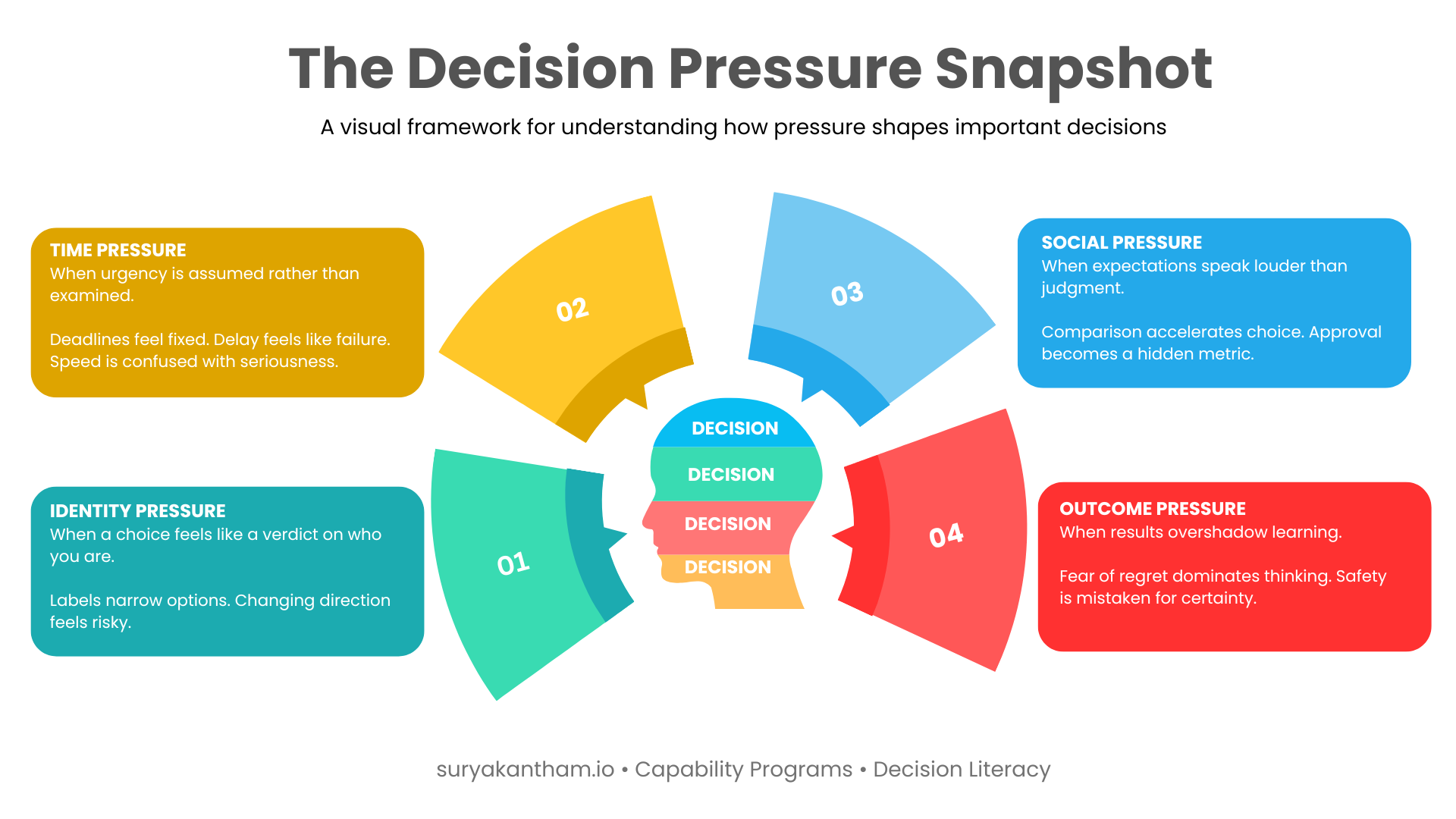
This snapshot illustrates the kinds of pressures that shape important decisions. In our programs, students learn how to work with these pressures—rather than react to them.
Across All Capability Programs
A developmentally sequenced capability framework spanning school, college, and early career transitions.
- Structured, not open-ended
- Developmentally appropriate to the student’s stage
- Grounded in reflection, experimentation, and judgment
- Delivered in collaboration with educational institutions
In college, students are often expected to decide just as uncertainty intensifies.
Questions about direction, identity, and next steps become harder to avoid, even as pressure to “figure it out” increases.
College-level Capability Programs are designed for this stage.
They are particularly well-suited to students navigating ambiguity around direction, identity, and next steps—especially where pathways are not pre-defined and outcomes are not immediately structured.
The focus is on:
- Separating identity from options
- Distinguishing reversible from irreversible choices
- Exploring interests without premature commitment
- Making thoughtful next moves without requiring full certainty
These programs are structured, reflective, and grounded in real decision-making contexts. They integrate alongside academic commitments rather than compete with them.
The intent is not a career decision.
What remains is a student who can navigate ambiguity with greater clarity, agency, and resilience.
Best suited for programs where exploration, judgment, and adaptability matter more than immediate placement outcomes.
In school years, the goal is not decision-making — it is preparation for future choice.
School-level Capability Programs support students as they begin to notice interests, encounter expectations, and form early narratives about who they are and what they are “good at.”
The focus is on:
- Preserving curiosity without locking identity
- Helping students recognize pressure without internalizing it
- Building comfort with exploration and uncertainty
- Developing reflective habits that mature over time
These programs are carefully scaffolded and age-appropriate. They do not push students toward streams, careers, or early conclusions.
The intent is not to rush clarity about the future, but to build the thinking skills that make clarity possible later.
What remains is a student who feels safer exploring, better able to reflect, and more prepared for the choices that will come later.